We have been saying for a while now that the next wave of attacks would not be smarter than the last. It would be faster than any team can react. We say it because almost every security programme we walk into still runs at a human tempo: someone notices, someone escalates, someone decides. That only works as long as the attacker needs time to think as well.
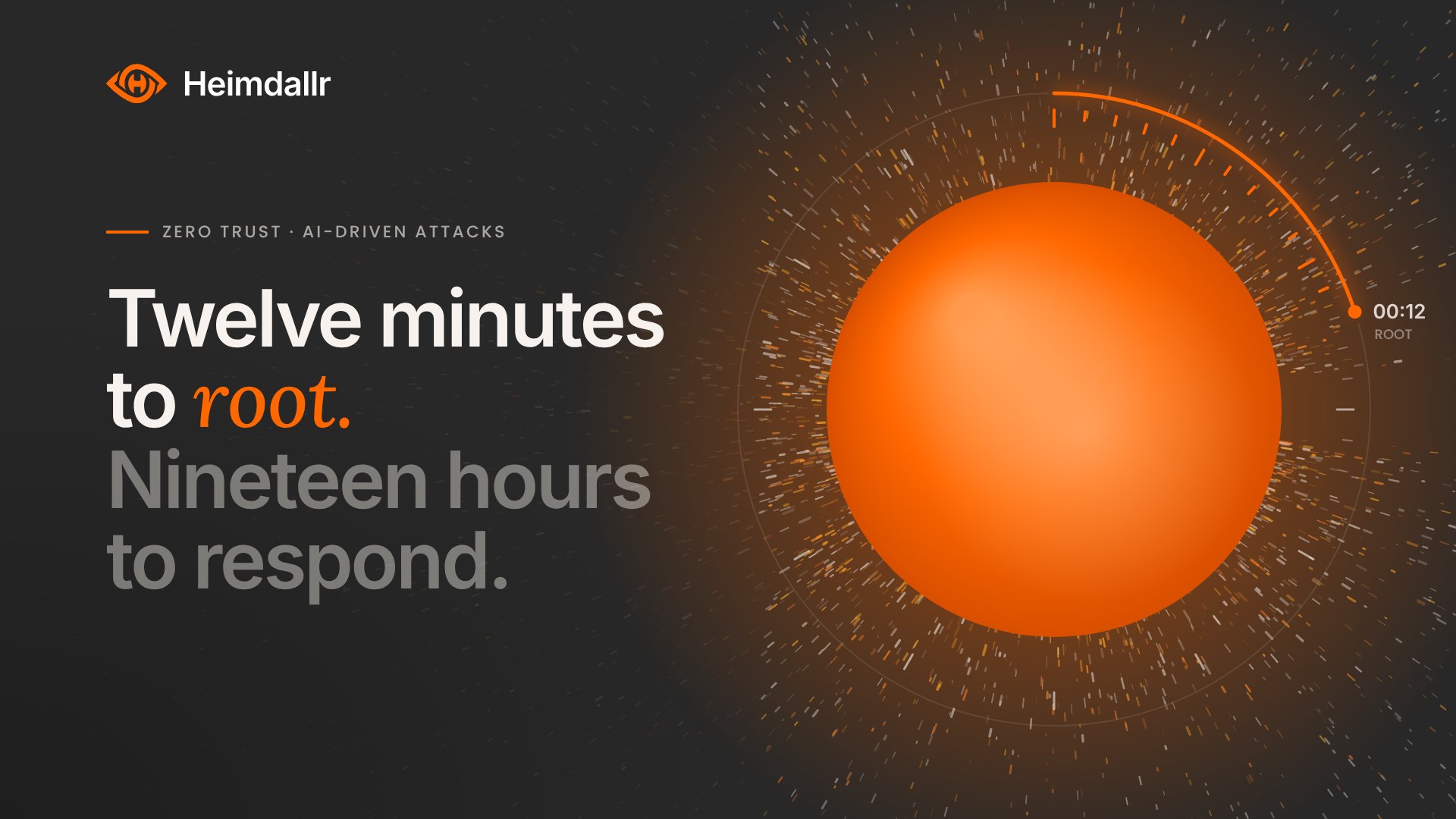
In September that assumption was tested on DIVD, the Dutch volunteer institute that finds vulnerabilities on behalf of the rest of us. An AI agent chained two unknown flaws in their helpdesk software and had root in twelve minutes. From there it did everything at once. It read a mailbox nine times, scanned the internal network, pulled login tokens from a database and tried to reset passwords at the hosting provider. DIVD counted more than 450,000 requests and over 2,500 scripts. A human intruder needs twenty or thirty.
What we find most telling is that DIVD spotted it within nineteen minutes. Detection worked. Containment still took nine hours and the response nineteen. That is no criticism of an organisation that has been remarkably open about every step. It is what happens when people have to out-decide software.
The tool
The tool behind the attack is called ARTEX: an open-source pentest framework, published in July, that lets a swarm of agents plan and carry out an intrusion on whatever language model you connect to it. There is no malware to detect and no model to ban. The developer pulled the project on 8 October, but the forks are still out there. Microsoft watched a China-aligned group use it to get from first targeting to privileged cloud access in under three hours, more than once. Eye Security, defending a European e-commerce company, found that each new block bought them about three minutes. Check Point puts the model costs of the campaigns it studied at 150 to 1,500 dollars.
Our principle
None of the techniques are new. Exposed web applications, leaked secrets, app identities with far too many rights. Which is why we do not think this is an AI story. It is an exposure story, and AI has taken away the time we used to hide behind. Speed only helps an attacker against things that can be reached.
So with clients we have stopped asking how fast they can respond. We ask how little a swarm would find. In our designs that comes down to three decisions. We will use Netskope to make them concrete, because a principle needs an example.
The first is to take applications off the internet. Behind Netskope Private Access there is no inbound connection to scan, and an agent cannot exploit a login page it cannot find. A helpdesk console that only staff use belongs there. The second is to grant access to one application, never to a network, and to keep judging behaviour for as long as the session lasts. Segmentation, DIVD says, is what kept the attacker from going deeper. This is segmentation taken to its conclusion. The third is to hold your own AI to the same rule. Netskope’s Skylight suite authenticates and logs every call to the models you host and, with the Agent Action Control it announced in September, puts a policy decision in front of each action an agent attempts. That matters twice. ARTEX crews are already stealing model keys to pay for their next run. And you will soon want agents of your own on the defending side, as Eye Security did: read-only, with people making the calls.
We should be honest about the limit. Nothing described here stops a zero-day in an application that has to face the public. What architecture decides is what the swarm finds once it is in, and how far those first twelve minutes carry.
Contact us and protect what matters most
At Heimdallr we design, build and migrate Zero Trust architectures as an independent specialist. We remove implicit trust wherever we find it, and we treat machine identities and AI agents as identities from day one. If a swarm were pointed at your organisation tonight, what could it reach before anyone woke up? We would like to hear your answer: info@heimdallr.nl.